The "Honda Boys": organized theft, not opportunism
If you've heard of the "Kia Boys," the viral social media trend that led to a wave of Kia and Hyundai thefts, the Honda equivalent is less viral but far more sophisticated. Where the Kia challenge was driven by teenagers exploiting a manufacturing oversight, Honda theft in 2025–2026 is being carried out by organized crime rings operating multi-vehicle caravans across cities.
In Philadelphia, the Major Crimes Unit has tied hundreds of Honda thefts to connected syndicates. Crews operate in coordinated groups: one vehicle acts as a lookout, another carries equipment, a third serves as transport for the stolen vehicle. They survey neighborhoods, move fast, and have disposal chains for both whole vehicles and stripped parts.
This isn't random. It's a business, and Hondas are the product.
Reason 1: The parts market
Honda parts are uniquely valuable for one reason that's also a nightmare for law enforcement: Honda parts carry no VIN numbers. A fender, hood, airbag, or engine component pulled from a stolen CR-V is completely untraceable once separated from the vehicle. It can be sold through gray-market channels, body shops, or online parts marketplaces with no way to connect it to the theft.
CR-V fenders sell for $200–400 each. Hoods: $300–600. Airbag assemblies can fetch over $2,000 on the secondary market. Impact sensors, grilles, engine components. A single stripped CR-V can yield $8,000–15,000 in resaleable parts. A crew that steals and strips three cars a week is running a very profitable operation.
The interchangeability compounds this. Because Honda uses similar parts across model years and across the CR-V, Accord, and Civic lines, a stolen 2022 CR-V's parts fit a wide range of vehicles. Demand is deep and consistent.
Reason 2: The OBD port vulnerability
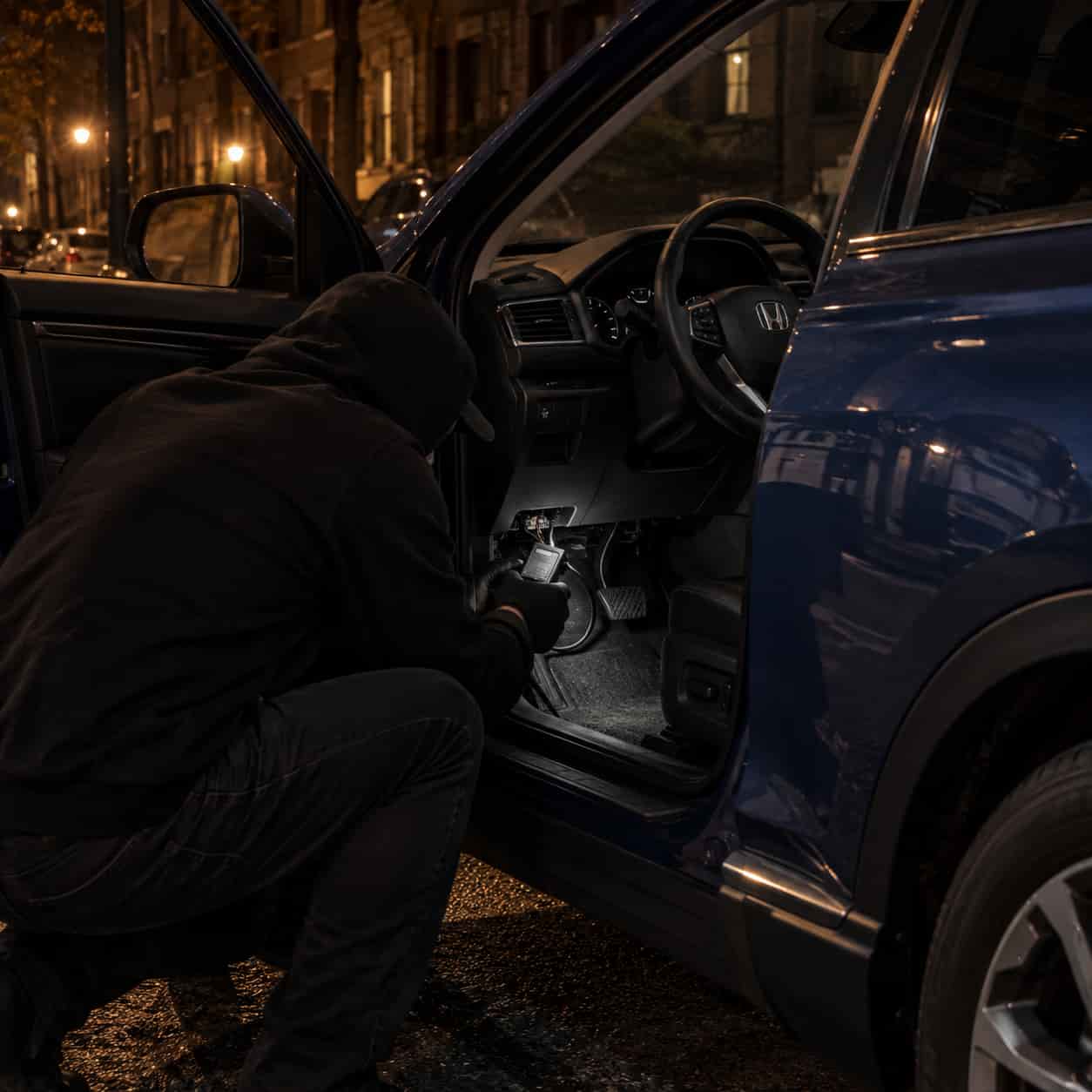
Modern Hondas, particularly the CR-V, Accord, and Civic from 2016 onward, use keyless entry and push-button start systems. The security relies on encrypted key fob communication. But there's a weak point: the OBD-II diagnostic port under the steering column.
This port is required by federal law on all vehicles. It allows mechanics to read error codes and diagnose issues. On many Honda models, it also allows external devices to interact with the car's key programming system. Thieves have obtained or built devices that clone a key fob's signal or program a blank key. The whole process takes under 60 seconds.
Philadelphia police specifically identified OBD port access as the dominant method in the current theft wave. In captured footage, crews approach the car, break a small window to get in, plug in the device, and drive away. No original keys needed.
The fix: An OBD port lock physically blocks the port, making it impossible to insert a programming device. It's a comparatively cheap solution to a problem that costs $40,000 to learn the hard way.
See the OBD-Lock →Reason 3: Front radar sensor theft
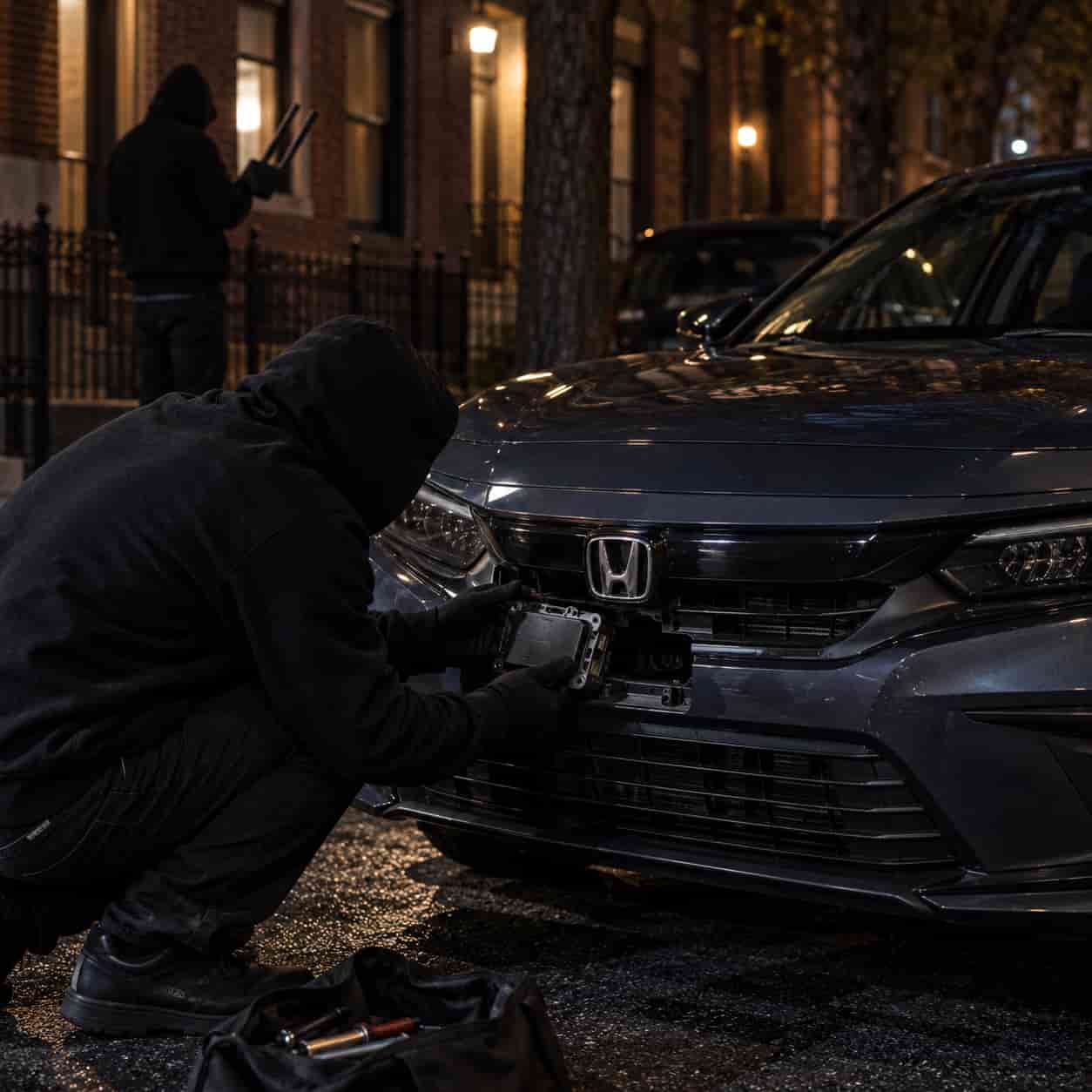
Honda Sensing runs through a suite that powers Adaptive Cruise Control, Collision Mitigation Braking, and Forward Collision Warning. The system through a millimeter-wave radar sensor mounted behind the front grille emblem. On 2023–2026 Accord and CR-V models, that sensor is a high-value, untraceable part sitting in a relatively accessible location.
Organized theft rings that strip Hondas for parts aren't only after engines and body panels. Electronics with strong secondary market demand and no VIN stamping are exactly what chop-shop operations move efficiently. A front radar sensor pulled from a stolen CR-V can be sold to a shop doing a replacement. It is completely untraceable once separated from the vehicle.
The OEM replacement cost for the sensor alone runs $500–1,500, with dealer-required calibration adding another $300–800. Total out-of-pocket often lands between $800 and $2,500. The sensor's absence also disables Honda Sensing entirely until replaced.
See the Miller CAT Radar Shield →Reason 4: Relay attacks on keyless entry
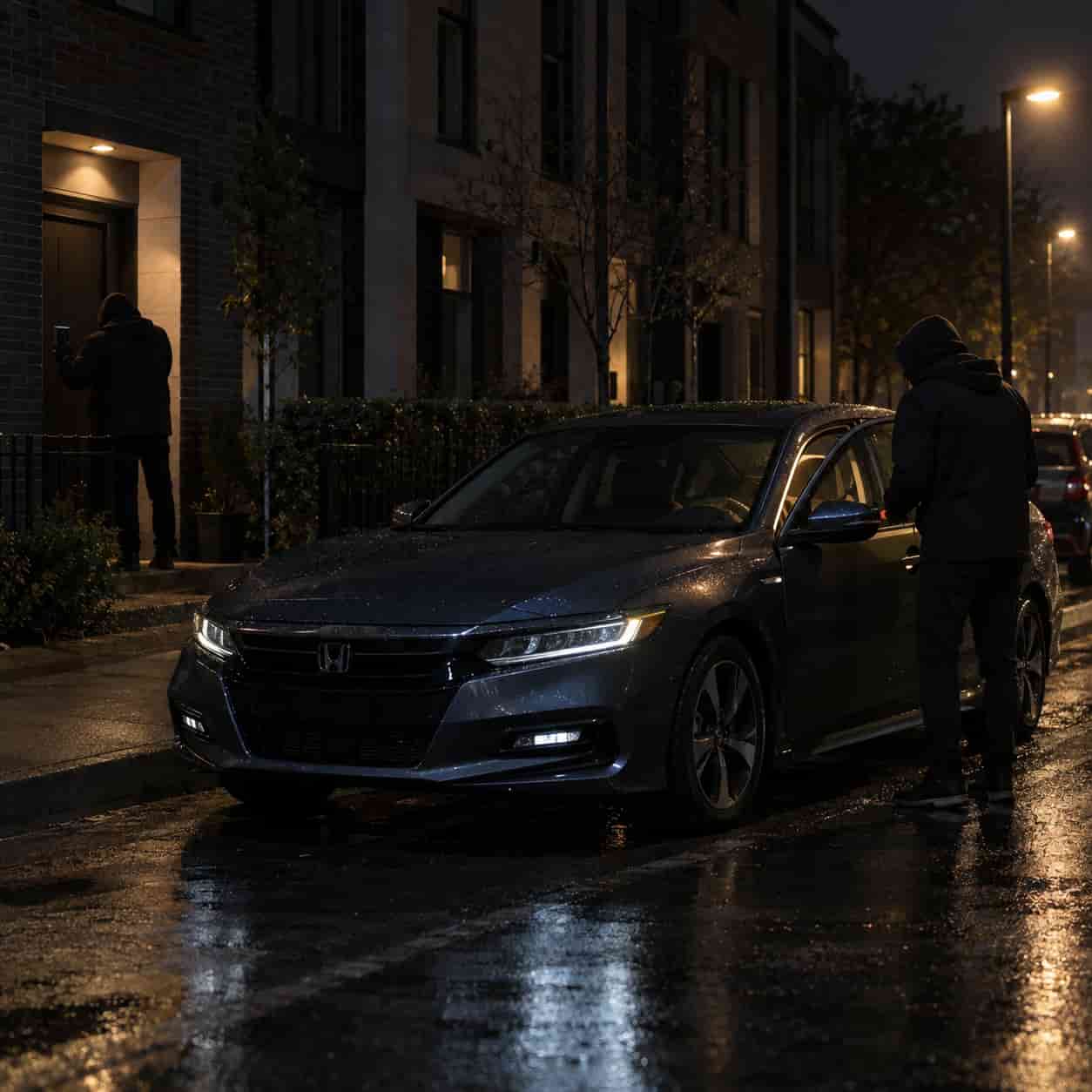
If your Honda uses keyless entry (where you just touch the door handle to unlock it) you're potentially vulnerable to a relay attack. This doesn't require OBD access or any forced entry. It works like this:
Two thieves, each with a signal amplifier, position themselves around your home. One stands near your front door (or wherever your keys are). The other stands near your car. The device amplifies your key fob's passive signal, tricking the car into thinking the authorized key is present. The car unlocks. The car starts. They drive away.
This attack works even when your car is in your driveway and your keys are on the kitchen counter 30 feet away. It's been documented on Hondas across Europe, Canada, and the U.S., and the frequency is increasing as crews adopt the technique.
The countermeasure is a Faraday pouch for your key fob, a signal-blocking sleeve that prevents the passive transmission from being amplified.
The data: Philadelphia as a case study
Philadelphia is not unique, but it's the most documented example of organized Honda theft. The numbers as of mid-2026:
- Over 8,100 vehicles stolen in Philadelphia through late July 2026
- Nearly 25% (approximately 2,000+) were Hondas
- Over 30% of thefts in some months were Honda-branded vehicles
- Philadelphia PD has busted at least two major theft rings specifically targeting Hondas
- The Major Crimes Unit is now leading Honda-specific investigations
Similar patterns have been documented in Boston, Chicago, and across New Jersey. This is a national problem with a local intensity in Philadelphia right now.
What actually works
The good news: the methods thieves use are well-understood, and targeted countermeasures exist for each. You don't need to spend thousands on a security system. A layered approach using three products under $200 combined addresses the primary threat vectors:
- OBD Port Lock: blocks electronic key programming, the #1 current theft method
- Steering Wheel Lock: visible deterrent that makes your car a harder target than the one next to it
- Radar Sensor Guard: protects the Honda Sensing module from parts theft
None of these are perfect. A sufficiently motivated, equipped crew can defeat any physical security measure given enough time. The goal is to make your car cost more time than it's worth, so they move to the next one.
See the Full Setup →Sources
- → NBC Philadelphia: Honda owners urged to protect vehicles as thefts climb in Philadelphia (2026)
- → 6abc: More cars stolen amid recent string of Honda CR-V thefts in Philadelphia (2025)
- → 6abc: Philadelphia police bust 2 car theft rings targeting Hondas (2025)
- → autoevolution: The "Honda Boys" Are Now a Thing (2025)
- → 6abc: Thieves target Honda SUVs, leaving them stripped inside Philadelphia parks (2025)